The Psychology of Control, Mono-Blue Decks in Magic: The Gathering
I think that when plotting out the game, the creators said: Let’s make wisdom a trickster-like force, and make it limiting; instead of creating a strategy, make the disruption of strategy its main trait. May their enemies perish by asphyxiation. Allow it to build up psychologically. After playing against a blue player several times, an opponent becomes defeated by the feeling that every possible action has been denied, installing the idea of limitation in their mind from the very start.
What makes mono-blue unique is that it does not need to overpower an opponent. Instead, it wins by creating limitations. A blue player restricts choices, delays threats, and slowly removes the opponent’s ability to execute their strategy. The most iconic embodiment of mono-blue’s philosophy is the Counterspell, which prevents threats from ever existing. What makes it appealing is that it is a common card, yet it can stand against god-like creatures or spells that would otherwise dominate the game.
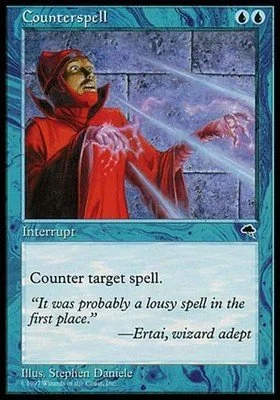
Wizards of the Coast. “Counterspell.” Magic: The Gathering, Tempest, 1997. Artwork by Stephen Daniele.
Two untapped Islands often make an opponent question whether their timing is right. This uncertainty creates a psychological battle where the blue player gains influence without even playing a card. A mono-blue player prevents threats from becoming meaningful by countering important spells, returning permanents, drawing cards, and controlling the pace of the game until the opponent has fewer and fewer options. Simply leaving two Islands untapped can completely change how an opponent plays, forcing hesitation and inefficiency. Mono-blue is considered one of the most strategic colors because it relies on reaction rather than aggression.
Blue creatures are canonically known for being weaker than those of other colors, but they compensate by relying on abilities rather than raw strength. Another important aspect of mono-blue strategy is information. Blue decks focus on drawing more cards and maintaining more options than the opponent. This is why forcing an opponent to lose cards from their library, commonly known as mill, feels naturally connected to blue. Winning through mill is not about attacking life totals, but attacking possibilities.
The opponent loses because their resources are exhausted. In this sense, treating the opponent’s library as their true hit points becomes the most logical blue strategy. A pair of Scalpelexis can do wonders in only a few turns. Or any other card. Whatever. Theoretically, a player only needs to stay one turn ahead to win.
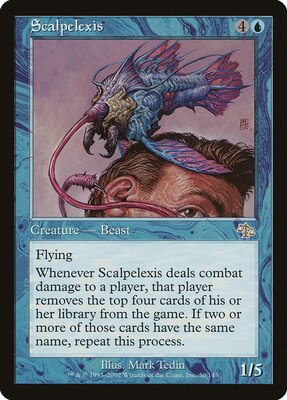
Wizards of the Coast. “Scalpelexis.” Magic: The Gathering, 10th Edition, 2007. Artwork by Mark Tedin.
The blue player is constantly calculating: What is the opponent trying to accomplish? Which card matters most? What should be stopped, and what should be ignored? Victory comes from making better decisions over time. Mono-blue represents one of the most unique philosophies in Magic: The Gathering. Rather than relying on aggression or overwhelming power, it wins through control, uncertainty, and exhaustion. Its greatest weapon is not the counterspell itself, but the fear and hesitation created by its possibility. A mono-blue player does not defeat an opponent by being stronger in the traditional sense; they slowly remove their ability to fight back.